|
|
|
Convincing Hospitals
That Glucose Management Matters
By Dan
Fleshler | Published on 23 October 2017
Patients'
blood glucose (BG) levels in many American hospitals
run dangerously high, but hospitals aren’t doing
nearly enough to address the problem.
Between 70% and 80% of patients with diabetes
experience hyperglycemia when they’re hospitalized
for critical illnesses or have cardiac surgery. And
about 30% of all inpatients experience high blood
sugars (>180 mg/dL). Even if you stay in the
hospital for just a few days, rising glucose levels
increase the mortality risk and the risk of eventual
kidney failure, poor healing, dehydration and other
problems. Meanwhile about 6% of hospital inpatients
experience potentially dangerous hypoglycemia (low
blood sugar) as well!
It doesn’t have to be this way. In this day and age
of continuous glucose monitoring (CGM) and closed
loop technology, hospital diabetes management has
the potential for a seismic shift -- if they choose
to adopt these newer innovations.
For example, recently on Oct. 18, the FDA approved a
first-of-its-kind CGM for surgical ICUs that can
monitor glucose levels and alert physicians and
hospital staff of any highs or lows. It's a sign of
the times, as this type of tech to monitor glucose
and dose insulin promises to improve patient health,
reduce hospital readmissions and cut health care
costs.
Yet only about 10% of Americans hospitals now use
these “e-Glycemic solutions,” says Linda Beneze, CEO
of Monarch Medical Technologies, which provides
high-tech glucose management systems to hospitals.
Read more > |
|
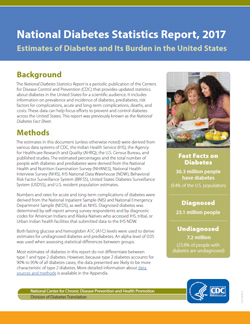 CDC
Releases 2017 National Diabetes Statistics Report CDC
Releases 2017 National Diabetes Statistics Report
The National Diabetes Statistics
Report is a periodic publication of the Centers for
Disease Control and Prevention (CDC) that provides
updated statistics about diabetes in the United States
for a scientific audience.
It includes information on
prevalence and incidence of diabetes, prediabetes, risk
factors for complications, acute and long-term
complications, deaths, and costs.
These data can help focus efforts
to prevent and control diabetes across the United
States.
Click here for a copy of the report. |
|
Management of
Inpatient Hyperglycemia
and Diabetes in Older
Adults
Diabetes Care 2017;40:509–517 | DOI:
10.2337/dc16-0989
Adults aged 65 years and older are the fastest growing
segment of the U.S. population, and their number is
expected to double to 89 million between 2010 and 2050.
The prevalence of diabetes in hospitalized adults aged
65–75 years and over 80 years of age has been estimated
to be 20% and 40%, respectively. Similar to general
populations, the presence of hyperglycemia and diabetes
in elderly patients is associated with increased risk of
hospital complications, longer length of stay, and
increased mortality compared with subjects with
normoglycemia. Clinical guidelines recommend target
blood glucose between 140 and 180 mg/dL (7.8 and 10 mmol/L)
for most patients in the intensive care unit (ICU). A
similar blood glucose target is recommended for patients
in non- ICU settings; however...
Read more |
|
Improving Glycemic Control Safely in Non-Critical Care
Patients: A Collaborative Systems Approach in Nine
Hospitals
Gregory A. Maynard, MD, MS, MHM; Diana
Childers, MD, FHM; Janet Holdych, PharmD, CPHQ; Heather
Kendall, RN, MSN, PHN; Tom Hoag, RN, BS; Karen Harrison,
RN, MSN, CCRN; The Joint Commission Journal on Quality
and Patient Safety 2017; 43:179–188
Hospitalized patients with uncontrolled hyperglycemia
are at increased risk for a variety of adverse outcomes,
including prolonged hospital stay, infectious
complications, and
death. In the United States, one in four adult
hospitalized inpatients has a known diagnosis of
diabetes, and another 12% have hyperglycemia without a
preexisting diagnosis. Hypoglycemia is also an important
inpatient problem. Insulin is one of the most common
sources of inpatient adverse drug events, and more than
half of these events are preventable. Professional
societies and standards organizations, on the basis of
consensus and local experience, have highlighted
the importance of optimizing inpatient glycemic control
and reducing hypoglycemia. Systematic reviews or
metaanalyses regarding large-scale efforts to improve
inpatient glycemic control and reduce hypoglycemia could
not be located in the literature.
In late 2011 Dignity Health (San
Francisco), the largest hospital provider in California,
set out to significantly improve hypoglycemia,
uncontrolled hyperglycemia, and glycemic control across
a diverse group of 9 hospitals within its 39- hospital
system in three states.
PDF |
Online |
|
From SCCM 2017
Revisiting Tight Glucose Control in the ICU:
Lower
mortality risk with lower glucose target
More stringent glucose control in
critically ill patients led to a lower mortality without
a significant increase in severe hypoglycemia,
possibly reopening a discussion that many experts
considered over, it was reported here.
Patients treated to a glucose
target of 80 to 110 mg/dL had a 36% lower 30-day
mortality compared with patients treated to a target of
90 to 140 mg/dL. The lower target was achieved
with less than 1% incidence of severe hypoglycemia.
More > |
|
Tight Glycemic Control in Critically Ill Children
M.S.D. Agus, D. Wypij, E.L. Hirshberg,
V. Srinivasan, E.V. Faustino, P.M. Luckett, J.L.
Alexander, L.A. Asaro, M.A.Q. Curley, G.M. Steil, and
V.M. Nadkarni, for the HALF-PINT Study Investigators and
the PALISI Network*
In multicenter studies, tight glycemic control targeting
a normal blood glucose level
has not been shown to improve outcomes in critically ill
adults or children after
cardiac surgery. Studies involving critically ill
children who have not undergone cardiac
surgery are lacking.
In a 35-center trial, we randomly
assigned critically ill children with confirmed
hyperglycemia (excluding patients who had undergone
cardiac surgery) to one of two ranges of glycemic
control: 80 to 110 mg per deciliter (4.4 to 6.1 mmol per
liter; lower-target group) or 150 to 180 mg per
deciliter (8.3 to 10.0 mmol per liter; higher target
group). Clinicians were guided by continuous glucose
monitoring and explicit methods for insulin adjustment.
The primary outcome was the number of intensive care
unit (ICU)–free days to day 28.
More > |
|
Precision Medicine, Glycemic Control and the Problems of
Identifying Friend from Foe
Mark E. Nunnally, MD, FCCM,
New York University Langone Medical Center
“Friendly fire” is a military concept that describes
risks to troops from their own weaponry during combat
operations. In broad terms, knowing the target and
hitting the target are key principles in avoiding
collateral damages. Medicine will never be combat, but
similar principles apply when one cannot identify and
treat the things that matter most in disease.
The lessons of tight glycemic control in the intensive
care unit are still being learned. The promise of a
simple, inexpensive and initially promising therapy have
devolved into uncertainties about harm. Enthusiasm for
tight protocols in response to large effect sizes in a
randomized, controlled trial could not be replicated in
larger studies. Explanations for the irreproducibility
and the suggestion of harm focused on hypoglycemia and
plasma glucose level variability. As enthusiasm waned,
interest shifted from maximizing benefits from tight
control to minimizing the harms of permissive
hyperglycemia.
More> |
|
Safety and Efficacy of Personalized Glycemic Control
in Critically Ill Patients: A 2 year Before and After
Interventional Trial
James S Krinsley MD, FCCM;
Jean-Charles Preiser MD, PhD; Irl B. Hirsch MD
Our understanding of the relationship of glycemia to
outcomes of critically ill patients has evolved
considerably in the 15 years since publication of the
first randomized trial of intensive insulin therapy.
Observational and randomized trial data have
demonstrated that hyperglycemia, hypoglycemia and
increased glucose variability are independently
associated with mortality. In addition, an emerging body
of literature has highlighted differences in the
relationship of glucose metrics to outcomes when
comparing patients with and without diabetes and a
review of the interventional trials of intensive insulin
therapy suggested greater benefit of treatment among
patients without diabetes.
Observational data has underscored the importance of
preadmission glycemia. Among a cohort
of critically ill diabetic patients, those with A1C
levels > 7% had higher probability of...
More
> |
|
Use of a
Computer-Guided Glucose Management System to Improve
Glycemic Control and Address National Quality Measures
A 7-Year Retrospective
Observational Study at a Tertiary Care Teaching Hospital
Robert J. Tanenberg, MD, FACP; Sandra
Hardee, PharmD, CDE; Caitlin Rothermel, MA,
MPH; Almond J Drake, 3rd, MD, FACE
Inpatient hyperglycemia, hypoglycemia, and glucose
variability are associated with increased
mortality. The use of electronic Glucose Management
Systems (eGMS) to guide intravenous
(IV) insulin infusion have been found to significantly
improve blood glucose (BG) control. This
retrospective observational study evaluated the 7-year
(1/2009-12/2015) impact of the
EndoTool® eGMS in intensive and intermediate units at
Vidant Medical Center, a 900-bed
tertiary teaching hospital.
More > |
|
A
Liberal Glycemic Target in Critically Ill Patients with
Poorly Controlled Diabetes?
Jan Gunst, Greet Van den Berghe,
Clinical Division and Laboratory of Intensive Care
Medicine, Department of Cellular and Molecular Medicine,
KU Leuven, B-3000 Leuven, Belgium
Due to severe physical stress, critically ill patients
commonly develop hyperglycemia. Multiple observational
studies have shown a U-shaped association between
glycemic levels in the intensive care unit (ICU) and the
risk of death, with the lowest risk of death associated
with glucose levels that are normal for age. Three
landmark randomized controlled trials (RCTs) performed
in Leuven and several subsequent single-center studies
found that treating pronounced hyperglycemia [>215 mg/dL
(11.9 mmol/L)] with insulin to target age-adjusted
normoglycemia [80–110 mg/dL (4.4–6.1 mmol/L) for adults,
60–100 mg/dL (3.9–5.6 mmol/L) for children, 50–80 mg/dL
(2.8–4.4 mmol/L) for infants] reduced morbidity and
mortality for both critically ill adults and children.
Soon after these landmark RCTs, many ICUs worldwide
adopted tight glycemic control (TGC) as part of their
standard of care. Unfortunately, worldwide
implementation of some degree of glycemic control
impeded the design of a repeat multicenter RCT.
Subsequent multicenter RCTs no longer compared TGC to
severe hyperglycemia, but to an intermediate glycemic
target, in general <180 mg/dL (10 mmol/L). Compared to
an intermediate target, these multicenter trials did not
find an outcome benefit from targeting normoglycemia and
the NICE-SUGAR study even found harm. Therefore...
More > |
|
